



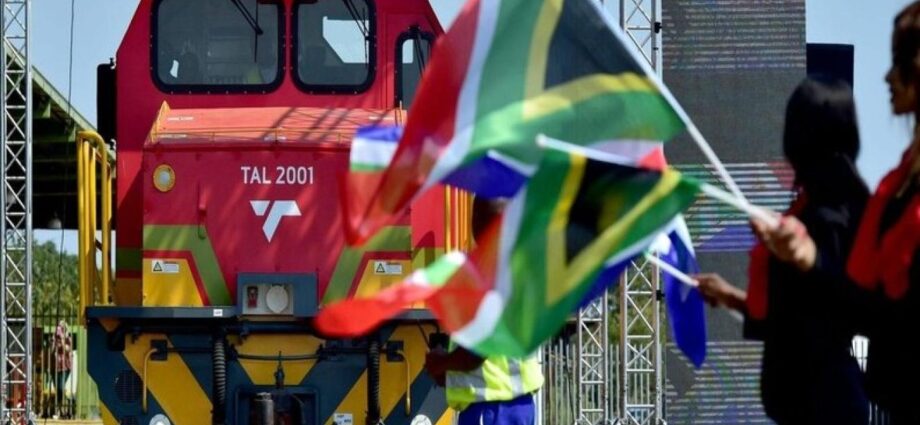
The past year marked a decisive, if uneven, shift in South Africa’s freight and logistics sector. Developments at Transnet dominated headlines throughout 2025, signalling both long-awaited reform and the lingering consequences of years of underinvestment during the state capture era.
As South Africa enters 2026, the logistics system stands at a familiar crossroads: genuine progress in ports and rail reform on one hand, and persistent congestion, security risks, and financial strain on the other. While landmark public–private partnerships and private capital injections pointed to a new trajectory, global trade disruptions and geopolitical shocks continued to test the resilience of the country’s supply chains.
Durban Pier 2 Deal Marks a Structural Breakthrough
One of the most significant milestones of the year came on December 10, 2025, when Transnet and International Container Terminal Services Inc (ICTSI) finally concluded a 25-year joint-venture agreement for Durban Container Terminal Pier 2. The partnership, structured through a special-purpose vehicle with Transnet retaining a 51% stake and ICTSI holding 49%, followed the KwaZulu-Natal High Court’s dismissal of APM Terminals’ legal challenge in October.
As the busiest container terminal in the country, Pier 2 is widely regarded as the flagship transaction of Operation Vulindlela Phase 2 and a critical test case for broader port reform. Industry stakeholders are now watching closely as the implementation phase begins in 2026.
New Port Equipment Begins to Ease Pressure
Transnet’s R3.4 billion equipment acquisition programme for the 2025/26 financial year began delivering tangible improvements toward the end of 2025. Durban received an initial deployment of 20 straddle carriers for Pier 2, along with nine Rubber-Tyred Gantry (RTG) cranes for Pier 1. In Cape Town, the commissioning of nine new RTGs contributed to a 32% year-on-year increase in refrigerated container volumes by August.
These deliveries form part of more than 100 new machines planned for Transnet Port Terminals nationally, offering cautious optimism that operational efficiency could improve further in 2026.
US Tariffs Disrupt Export Markets
South African exporters faced a major external shock when a unilateral 30% tariff imposed by the United States came into effect in early August 2025. The measure forced exporters to urgently diversify markets and underscored the importance of competitive logistics infrastructure in maintaining global trade relevance.
The tariff impact reinforced concerns about South Africa’s exposure to geopolitical shifts beyond its control, particularly in a period of fragile global trade flows.
AGOA Renewal Remains Uncertain
Compounding trade uncertainty was the expiry of the African Growth and Opportunity Act (AGOA) in September 2025. While the US House Ways and Means Committee approved the AGOA Extension Act on December 10—proposing a three-year renewal through to the end of 2028 with retroactive duty-free benefits—South Africa’s continued participation remains under threat.
US Trade Representative Jamieson Greer publicly described South Africa as a “unique problem,” signalling that exclusion remains a possibility unless tariff and non-tariff barriers on US goods are reduced. Although the House bill does not explicitly remove South Africa, a more aggressive Senate proposal, known as AGOA 2.0 and introduced by Senator John Kennedy, specifically calls for the country’s exclusion and mandates a broader review of bilateral relations.
As of early 2026, exporters remain in limbo, with the outcome likely to shape trade strategy for years to come.
Red Sea Disruptions Redefine Global Shipping Routes
Throughout 2025, ongoing instability in the Red Sea entrenched the Cape of Good Hope as the primary alternative shipping route between Asia and Europe. Sub-Saharan port connectivity surged by nearly 55% as vessels rerouted around southern Africa.
While Durban and Cape Town benefited from increased bunkering activity, the longer routes added weeks of transit time and millions of dollars in additional costs to global supply chains—pressures that are expected to persist into 2026.
Momentum Builds in State Capture Prosecutions
A significant legal development occurred in November 2025 when the Investigating Directorate Against Corruption (IDAC) added former Minister of Public Enterprises Dr Malusi Gigaba as the fifth accused in the high-profile Transnet corruption case.
Gigaba faces corruption charges linked to the alleged irregular awarding of locomotive contracts between 2010 and 2014. He joins former Transnet executives Brian Molefe, Anoj Singh, Siyabonga Gama, and Thamsanqa Jiyane. The matter was postponed to January 30, 2026, for disclosure of the docket and transfer to the High Court, marking a critical step toward accountability.
Rail Reform Gains Ground—Slowly
Rail reform emerged as one of the most structurally important developments of 2025. Following the publication of the foundational Network Statement in late 2024, Transnet Rail Infrastructure Manager (TRIM) concluded its first slot allocation process in August 2025.
Minister of Transport Barbara Creecy announced that 11 private Train Operating Companies were conditionally granted access to 41 routes across six key corridors, including the North Corridor and Iron Ore Line. The reform is expected to unlock up to R100 billion in private rolling stock investment and add an estimated 20 million tonnes of freight annually from the 2026/27 financial year.
By August 2025, rail’s share of total freight payload had risen to 14.5%, up 3.2 percentage points year-to-date—the strongest performance in years, though still well below the historical average of around 22%. Security incidents and derailments continued to divert cargo to road, where freight volumes declined by 5.8% in the first nine months of the year.
Traxtion’s announcement of a R3.4 billion investment in new and refurbished locomotives and wagons—the largest private freight rail investment in South African history—was a notable confidence signal, with deployment planned from 2026.
Port of Gauteng Advances to Planning Stage
In October 2025, the long-awaited White Paper for the proposed R50 billion Port of Gauteng inland port was officially launched. The project aims to relieve pressure on the Durban–Gauteng corridor through a multimodal logistics hub and is projected to create up to 50,000 direct and indirect jobs once fully operational.
Competition Authorities Target Shipping Lines
In a move with potential global implications, the Competition Commission referred eight international shipping lines to the Competition Tribunal on December 3, 2025, over alleged price-fixing through General Rate Increases imposed between 2008 and 2018. The case is expected to be closely watched by cargo owners and carriers alike in 2026.
Looking Ahead to 2026
As South Africa moves deeper into 2026, the freight sector is navigating calmer waters than in recent years—but the voyage is far from complete. The Pier 2 partnership, renewed equipment investment, private rail capital, and third-party access reforms all signal a long-overdue shift in direction.
Yet entrenched challenges remain. Port congestion, infrastructure theft, skills shortages, and Transnet’s debt burden continue to constrain a full-scale turnaround. Whether the gains of 2025 translate into sustained improvement will depend on disciplined execution, policy certainty, and the ability to withstand an increasingly volatile global trade environment.
