



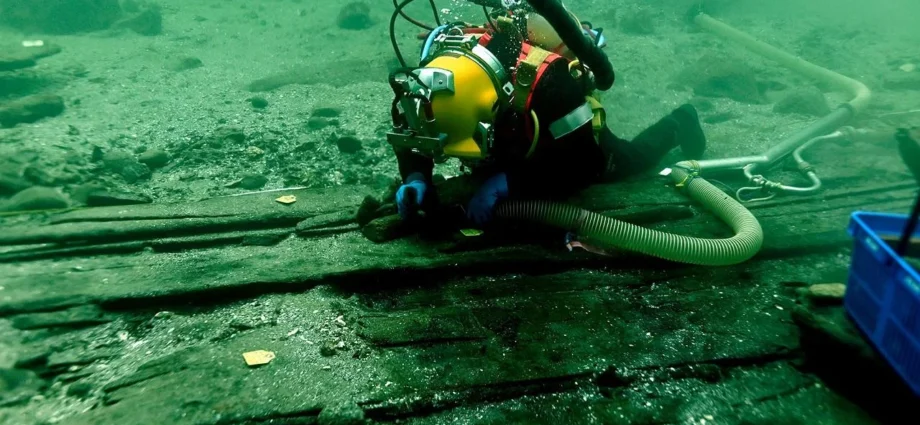
Maritime archaeologists from Denmark’s Viking Ship Museum have made a groundbreaking discovery: the world’s largest cog, a type of sturdy cargo and warship that dominated northern European seas from the 10th to 17th centuries.
The find, made in the Øresund Strait between Denmark and Sweden during seabed investigations for Copenhagen’s new district, Lynetteholm, offers unprecedented insight into medieval shipbuilding, trade networks, and maritime life.
From the very first dive, archaeologists realised they had uncovered something extraordinary. As layers of centuries-old sand and silt were removed, the outline of a remarkable vessel emerged: not just any wreck, but the largest cog ever discovered, a ship type considered the backbone of northern European trade during the Middle Ages.
“This is a milestone for maritime archaeology,” said Otto Uldum, excavation leader and maritime archaeologist. “Svælget 2 is the largest cog we know of, and it provides a unique opportunity to understand both its construction and life aboard the largest trading ships of the Middle Ages.”
Named Svælget 2 after the channel where it was found, the ship measures approximately 28 metres long, nine metres wide, and six metres high, with an estimated cargo capacity of 300 tonnes. Built around 1410, it represents the largest example of its type ever discovered.
According to the archaeologists, a ship of this magnitude indicates a society with a sophisticated trade infrastructure. “A vessel with such capacity reflects a structured system where merchants knew there was demand for the goods they carried. Svælget 2 is a tangible example of medieval trade development,” Uldum explained.
The cog was a highly efficient ship, capable of being sailed by a surprisingly small crew even when fully loaded. Large cogs like Svælget 2 were built to navigate the challenging waters from the Netherlands around Skagen and through the Øresund to the trading towns of the Baltic.
“This ship points directly to the extensive trade networks that linked northern Europe in the 15th century,” said Uldum. “Everyday goods were moved in large quantities – salt, timber, bricks, and staple foods. Shipbuilders went as big as possible to transport these bulky cargos efficiently.”
Developed in the North Sea region, the cog revolutionised trade. Its large cargo capacity allowed merchants to transport ordinary commodities over long distances for the first time, transforming economic patterns in the 14th and 15th centuries. Luxury items were no longer the only goods moved across the seas; essential products could now be shipped efficiently and at low cost.
“The cog truly transformed trade in northern Europe,” said Uldum. “It made large-scale transport of goods possible, enabling commerce on a scale previously unimaginable.”
Svælget 2 is not only a remarkable archaeological discovery but also a vivid testament to the ingenuity, organisation, and ambition of medieval northern European society.
