



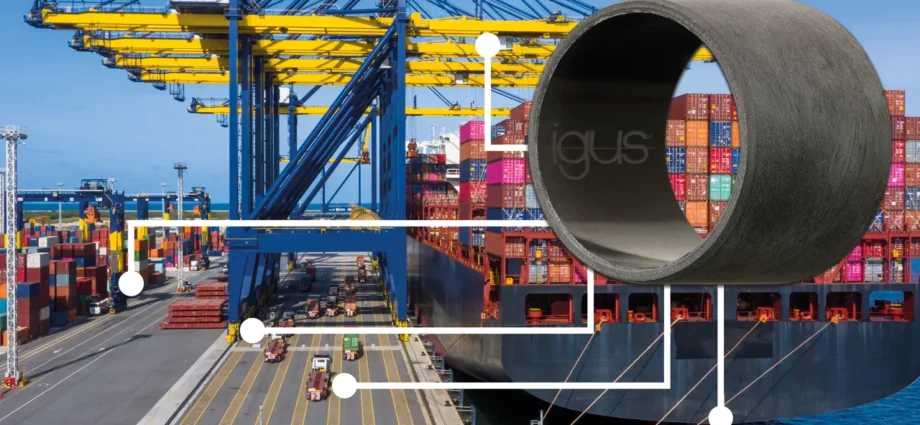
Polymer technology is rapidly reshaping the industrial machinery and lifting equipment landscape, offering performance advantages that are increasingly surpassing traditional steel bearings. As engineering demands evolve and operating environments become harsher, high-performance polymers are proving to be stronger, more durable and more cost-effective for a wide range of lifting applications.
Leading polymer bearing manufacturer igus has been at the forefront of this transition. The company produces an extensive range of lubrication-free, corrosion-resistant polymer bearings designed to deliver long service life in conditions where dirt, moisture, chemicals and abrasive particles would quickly degrade steel components. Engineered from tribologically optimised materials, these bearings minimise wear even under heavy loads — making them ideal for lifting machinery operating in demanding environments.
Performance in “Dirty” Operating Environments
According to Juan-Eric Davidtz, product manager at igus South Africa, polymer bearings are proving particularly valuable in industries such as timber processing, construction and mining, where equipment is exposed to harsh contaminants daily.
“Sawdust, sand and grit that typically cause steel bearings to seize or wear out prematurely have minimal effect on polymer surfaces,” he explains. “This means reduced downtime, greater operational consistency and significantly lower maintenance costs.”
By eliminating the need for external lubrication, polymer bearings also remove one of the most common failure points in heavy lifting machinery: inconsistent greasing in challenging environments.
Versatile Across Industries and Applications
Beyond heavy lifting, polymer bearings are gaining rapid acceptance across diverse industrial sectors. Their lightweight design, vibration-damping properties, resistance to chemicals and adaptability to specific temperature or load requirements allow them to outperform steel in many real-world scenarios — especially where lubrication cannot be guaranteed or contamination is unavoidable.
Top 10 Lifting Applications Where Polymer Bearings Replace Steel
Polymer bearings are now being used successfully in critical lifting equipment components that require reliability, durability and minimal maintenance:
-
Scissor lifts – For high-load pivot points subjected to frequent cycling.
-
Forklifts – In steering systems, mast components and linkages operating in dusty or wet environments.
-
Boom lifts & cherry pickers – Articulating joints supporting heavy work platforms.
-
Crane booms & hoists – Corrosion-resistant, low-maintenance pivot interfaces.
-
Dock levellers – Hinges and pivots exposed to ongoing movement and debris.
-
Hydraulic lift tables – Bushings and pins that sustain significant compression forces.
-
Mobile platform lifts – Bearings that ensure stable, smooth operation in all positions.
-
Warehouse stackers – Heavy-duty pivot points in compact, high-use machinery.
-
Material handling trolleys – Wear-resistant elements handling repetitive loads.
-
Telehandlers & telescopic lifts – Long-life joints requiring zero lubrication.
A Shift in Engineering Mindset
Davidtz notes that widespread adoption is closely tied to education and awareness among engineers and technicians who have traditionally relied on steel bearings and regular lubrication.
“Many users are still unaware of the high-performance characteristics of modern polymers. In numerous cases, simply switching to polymer bearings reduces maintenance costs dramatically — sometimes by hundreds of thousands of Rands per year.”
He adds that companies that have transitioned to polymer solutions consistently report more reliable machine operation and reduced maintenance needs, particularly in harsh industrial settings.
