



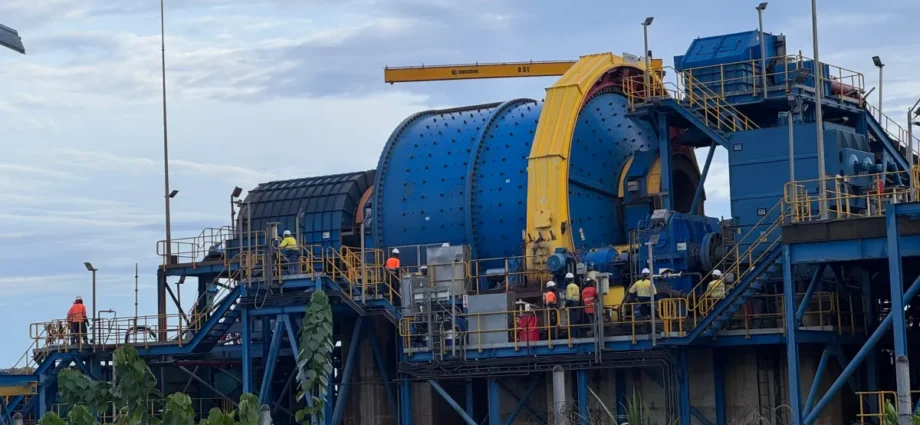
A purpose-designed transfer chute has significantly improved screening efficiency and overall process stability at an iron ore mine in Sierra Leone. Drawing on its extensive expertise in dry bulk materials handling, Weba Chute Systems successfully addressed persistent transfer point challenges within the mine’s wet processing plant.
The operation had been struggling with ongoing screening inefficiencies that were negatively affecting plant performance. According to Technical Director Dewald Tintinger, the root cause was traced to poor chute design, which resulted in uneven material distribution.
Material was not being directed onto the centre of the screens as intended. Instead, nearly 80% of the feed was forced to one side of the two screens at very high velocities. This imbalance caused wet, sluggish material to overwhelm the conveyor belt, leading to excessive spillage and frequent downtime for cleaning. As a result, only a small portion of the screening surface was being used effectively, further reducing separation efficiency.
To resolve the issue, a detailed assessment of material flow behaviour was conducted. While the application involved wet material, the underlying challenge remained consistent with dry handling systems—understanding and controlling how material moves through the chute. The presence of water, however, added complexity to predicting flow patterns within the existing layout.
To refine the design and minimise uncertainty, the engineering team used Discrete Element Modelling (DEM). This advanced simulation technique enabled them to analyse material distribution, velocities and impact points across the screen decks before finalising the chute design.
The redesigned chute incorporated several key features aimed at delivering a more uniform and controlled feed at lower velocities. A critical objective was to ensure equal mass flow to both screens. Previously, the system produced a natural 60/40 split due to the rotational dynamics of the upstream mill.
To correct this, an adjustable valve was introduced, allowing operators to fine-tune the flow split to an even 50/50. The valve also adds flexibility by enabling operators to divert 100% of the feed to a single screen during maintenance, improving overall plant uptime.
Further improvements included the addition of diverter gates and flood boxes positioned above each screen. These components allow slurry and water to accumulate and overflow evenly across the full width of the screen decks, rather than striking the surface in a concentrated, high-energy stream. This not only improves material distribution but also reduces discharge velocity, increasing retention time on the screens and enhancing separation efficiency.
Collaboration was key to the project’s success. Weba Chute Systems worked closely with the screen manufacturer, Sandvik Rock Processing, as well as the mine’s operations team to diagnose the issue and implement a coordinated solution. Each party contributed targeted improvements to ensure that chute design, operating practices and screen configuration were aligned.
The project also required local fabrication of key chute components in Sierra Leone to meet tight deadlines. Weba Chute Systems supported on-site manufacturing in accordance with its specifications, while providing quality control, installation assistance and commissioning support.
The result is a robust, practical solution that not only resolves the initial performance issues but also demonstrates the importance of combining sound engineering design with real-world implementation and collaboration.
